The inverse relationship expressed in the Phillips Curve tells us that we can't have both very low inflation and very low unemployment at the same time.
As the economy moves toward full employment (low unemployment), it becomes harder and harder for businesses to hire good employees. To compensate, businesses offer higher wages to attract good employees, which forces the businesses to raise prices on their products and services. Thus, the unavoidable result of low unemployment is high inflation.
Opposingly, as the economy cools down, businesses begin laying off employees and the unemplyment rate goes up. As more and more people become unemployed, there are fewer and fewer consumers who can afford to buy goods and services. Thus, the benefits of low inflation are usually accompanied by high unemployment.
The picture shows data from the 1960's.


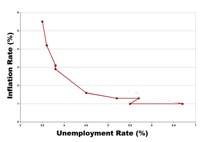 The Phillips Curve tells us that: